 Portals
 zaps connect supported tokens to DeFi positions through routed entry
Portals zaps combine the swaps, cross-chain transfers, and deposits needed to enter a selected DeFi position from a supported token. The route connects an input asset and source network with the chosen destination position. Portals supplies discovery and opportunity information, while Relay handles cross-chain routing and settlement. Checking that relationship means matching the route to the intended holding, then interpreting transfer status within its scope. A quoted output describes the proposed entry; a completed transfer records delivery to its stated destination.
Updated ·
A Relay Success status confirms delivery; the received asset must also match the holding a Portals zap was intended to establish.
Input Token and Source Network
The starting token and its network define the source side of a zap, so both must match the intended input. Explorer provides asset and chain filters for identifying relevant opportunities. The source network describes where the input holding exists; the destination network describes where the selected position exists. These choices can coincide or differ.
An input check passes when the selected asset and network match the holding intended for the route. A familiar token name alone leaves the network unresolved. If the proposal uses a different asset or source network, resolve that mismatch before authorizing entry. This checks compatibility with the intended transaction, without assuming every possible token and destination combination has an available route.
Swaps, Cross-Chain Transfers, and Deposits
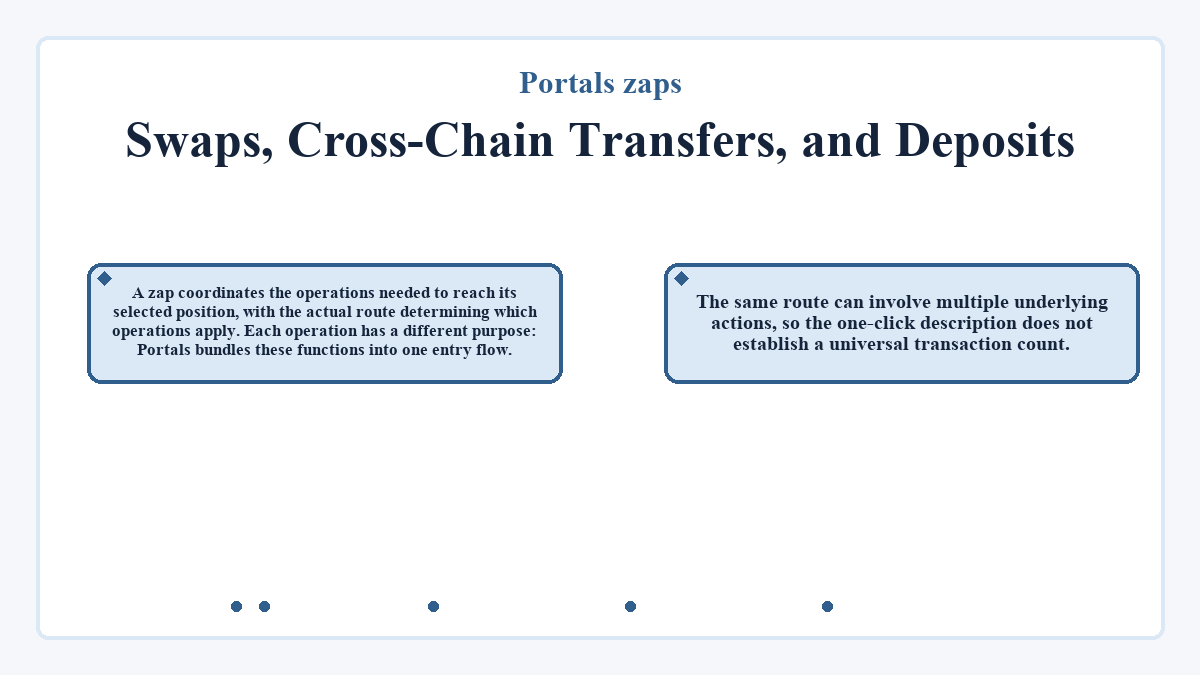
A zap coordinates the operations needed to reach its selected position, with the actual route determining which operations apply. Each operation has a different purpose:
- Swap
- Converts a supported input asset into another asset required along the route.
- Cross-chain transfer
- Moves value between the source network and the destination network.
- Deposit
- Enters the chosen DeFi position using the asset its entry mechanism accepts.
Portals bundles these functions into one entry flow. The same route can involve multiple underlying actions, so the one-click description does not establish a universal transaction count.
Portals Discovery and Relay Routing
Portals presents the destination opportunity, while Relay is the primary router for Portals swaps and zaps, including cross-chain entry.
Opportunity information identifies the underlying pool, vault, lending market, or staking position. Portals also supplies yield and liquidity information for comparing those holdings. Those details concern the destination exposure, rather than transfer progress.
Relay provides cross-chain routing and settlement for Portals Explorer. Its role covers finding the path and moving assets between networks.
Portals announced Explorer's cross-chain entry on September 2, 2026. The integrated flow brought into Explorer a capability already available through the developer API. Supported routes remove the need to arrange a manual bridge before swapping and depositing.
Same-Network and Cross-Network Entry
A same-network route can connect a starting token with a position without requiring a cross-chain transfer solely to reach another protocol. A cross-network route also needs to move value into the destination network. The relevant difference is the relationship between the source and destination chains, not the number of protocols appearing in discovery. Check those network names alongside the selected position: a chain filter narrows the destination search, while the route must accommodate the actual source holding.
Destination Position and Received Asset
The destination check asks whether the route targets the intended position on the chosen network and what its output represents. Pools, vaults, lending markets, and staking positions involve different holdings. Receiving a token associated with a protocol does not automatically identify a particular market or vault. The selected position supplies that context, so its identity belongs beside the output asset in the route review.
Output quantities use the units of the asset being received. They do not automatically represent equivalent units of the starting holding. This distinction matters when entry changes both the token and the type of exposure.
From ETH to sUSDS Through Osero Earn
The proposed holding in this hypothetical example is sUSDS through Osero Earn on Base, reached from ETH on Ethereum through an assumed available route.
The route connects the Ethereum input with the Base destination, combining asset conversion and cross-chain movement as needed. Relay handles cross-chain routing and settlement. Osero Earn provides the savings infrastructure used by the Portals sUSDS integration, which supports access on Ethereum, Base, Arbitrum, and Optimism.
The received sUSDS is the savings token for Sky's USDS stablecoin and accrues value against USDS. Its balance does not rebase as savings accrue. Assessing the holding therefore involves its sUSDS token count and the USDS value each token represents.
If this hypothetical zap completes with sUSDS delivered on Base to the intended recipient, the destination check passes because the received asset and network match the proposed holding. A proposal naming another output asset or network describes a different entry. The route quote gives the expected sUSDS quantity; the actual output is the sUSDS received when entry completes.
Quoted Output and Slippage Controls
Portals includes built-in slippage protection in its routing, making exchange terms part of the entry review. Slippage concerns the difference between expected and executed exchange terms. Read the proposed output in its stated token units, alongside the constraints attached to that route. Any displayed costs also belong to the proposed execution; a yield figure describes the position being entered.
A quoted amount and the amount recorded as delivered refer to different states of the transfer. Relay's Fill details report what arrived. The quote describes what the proposed route expects to produce under its terms.
What Does Relay Success Mean for a Portals Zap?
Relay's Success status confirms the transfer completed and its funds were delivered. The Fill side identifies the destination chain, recipient address, and exact amount received.
Processing means the transfer remains underway. Do not send a second transfer while it is in this state. A prolonged delay calls for a support query with the transfer details.
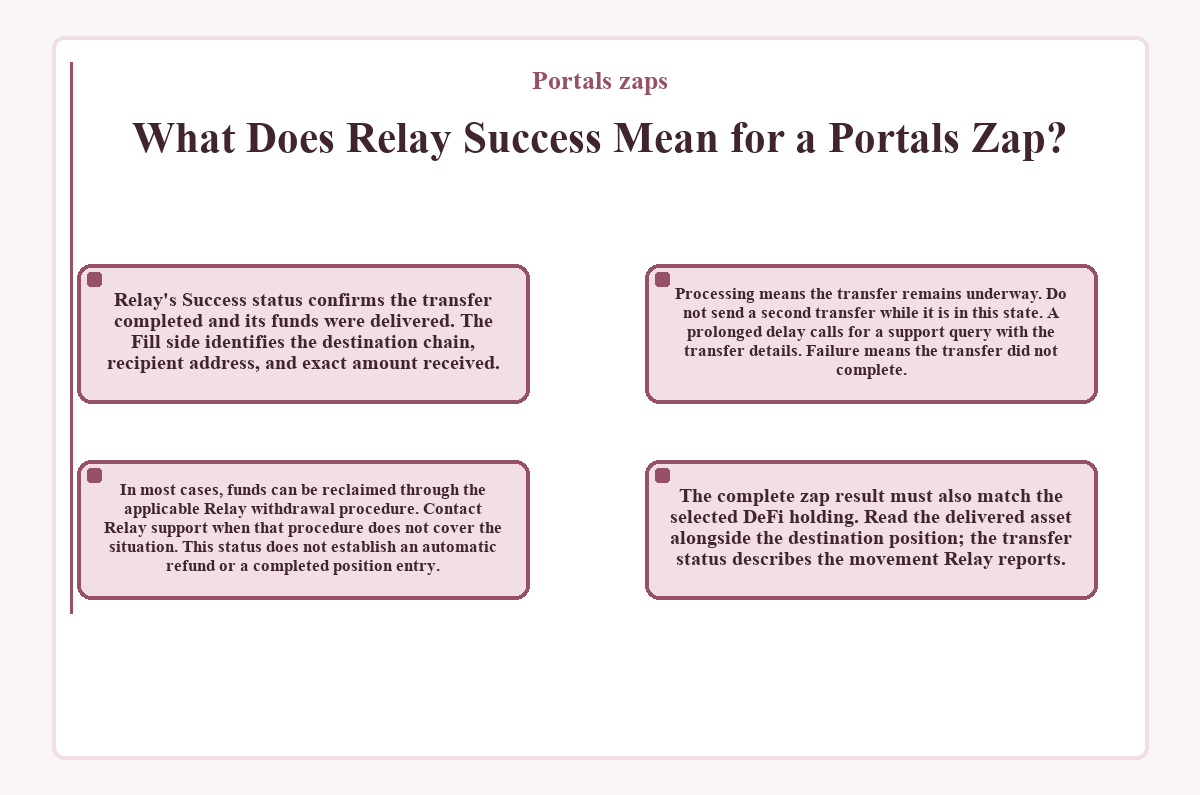
Failure means the transfer did not complete. In most cases, funds can be reclaimed through the applicable Relay withdrawal procedure. Contact Relay support when that procedure does not cover the situation. This status does not establish an automatic refund or a completed position entry.
The complete zap result must also match the selected DeFi holding. Read the delivered asset alongside the destination position; the transfer status describes the movement Relay reports.
Completed Transfers and Missing Wallet Balances
Funds from a completed Relay transfer may remain invisible when the wallet's network, token list, or open account does not match the Fill record. Compare the destination network and recipient with the wallet being viewed. An unlisted token may require a manual token entry using its contract address. Use the contract for the received asset on the destination network, so the display refers to the actual delivery.
A recipient address outside your control creates a different problem from a hidden token balance. Relay cannot reverse a transfer delivered to that address. Contact Relay support with the transaction details. Adding a token to a wallet's display can reveal a balance; it does not change which address received the funds.
Destination Eligibility and Final Route Choice
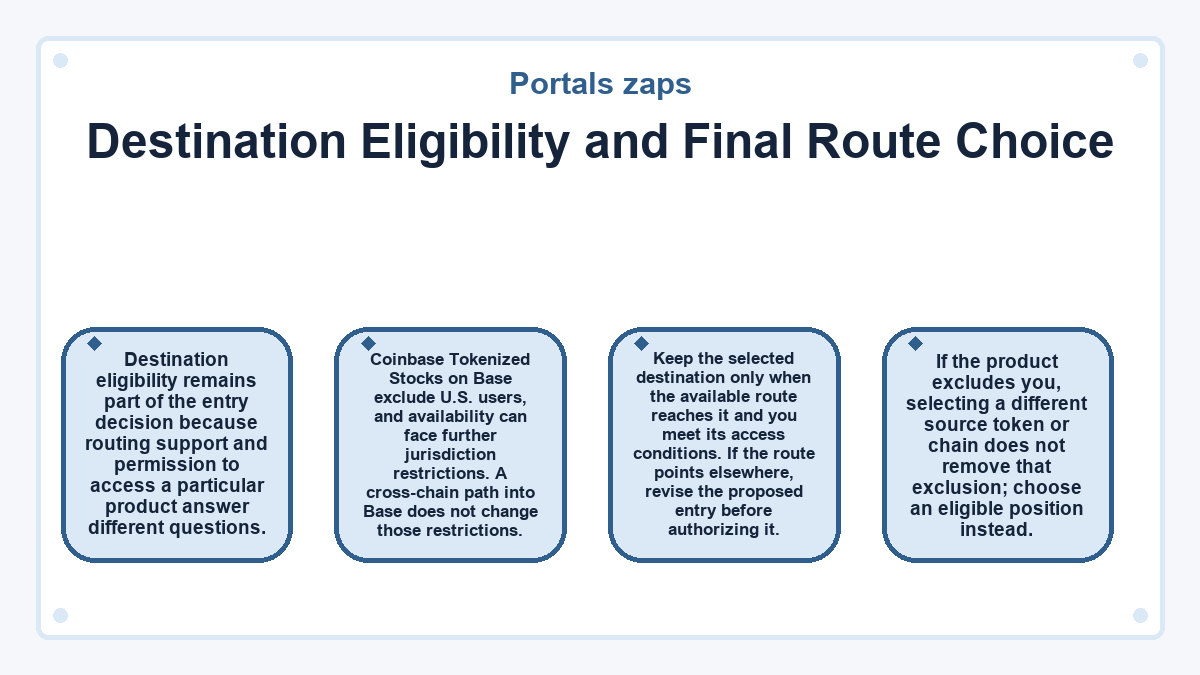
Destination eligibility remains part of the entry decision because routing support and permission to access a particular product answer different questions. Coinbase Tokenized Stocks on Base exclude U.S. users, and availability can face further jurisdiction restrictions. A cross-chain path into Base does not change those restrictions.
Keep the selected destination only when the available route reaches it and you meet its access conditions. If the route points elsewhere, revise the proposed entry before authorizing it. If the product excludes you, selecting a different source token or chain does not remove that exclusion; choose an eligible position instead.
Portals zaps FAQs
How Long Can a Relay-backed Portals Zap Take?
Most Relay transfers arrive within moments, although this is not a guaranteed completion time for an entire zap. Source-chain confirmation affects when a new transfer first becomes visible. Use the transfer's actual status to judge progress, and seek Relay support if Processing persists far longer than expected.
Where Should I Look for a Relay Transfer Started Inside Portals?
Search Relay's transaction history using the full deposit transaction hash or the address the application actually sent from. An app-originated transfer may require a different sending address from the wallet address initially searched. Partial hashes and addresses do not match; a very recent transfer may need source-chain confirmation before it appears.
Which Details Does Relay Support Need to Trace a Delayed Zap?
Relay support needs the transfer's transaction-page link or the full deposit transaction hash. The hash must identify the source deposit associated with the zap. A complete identifier gives support a specific transfer to trace, including when the transfer began inside another application.
Do Exchange Accounts Display a zap's Received Funds Immediately After Relay Reports Success?
An exchange or smart contract wallet may credit its account balance on its own schedule after funds reach the chain. Relay Success confirms the recorded transfer delivered funds; it does not specify the receiving provider's crediting time. Match the recorded recipient and destination with the account expecting the deposit.
Who Provides the Savings Mechanism When a Zap Enters sUSDS Through Osero Earn?
sUSDS is the yield-bearing form of Sky's USDS, and its yield follows Sky's savings rate. Osero Earn supplies the savings infrastructure for the Portals integration. The savings rate can change.